
Wrapocalypse Now: Part 1 of 3
"It is just a wrapper" has become too blunt a phrase to do the work investors are asking it to do. It mistakes naming for analyzing. Part one of a three-part series replaces the lazy dismissal with a better vocabulary for understanding the AI application layer.
- 01"Just a wrapper" collapses structurally different companies into one bucket. It is naming, not analyzing.
- 02The world's most valuable companies, NVIDIA, Apple, Salesforce, Stripe, Netflix, all sit above substrates they do not own. Position alone does not predict outcome.
- 03The right question is not whether something is a wrapper, but what kind of wrapper, and what compounds above the substrate.
A Foreword
Walk into almost any partner meeting in 2026 and you will hear some version of the same dismissal:
"It is just a wrapper. Why would I pay enterprise SaaS multiples for something OpenAI or Anthropic is going to absorb in eighteen months?"
It sounds analytical. And sometimes, to be clear, the speaker is right. There really is a graveyard of thin GPT-3-era products that ChatGPT/Claude, etc. vaporized on launch. Companies whose entire product is (was) a prompt, a UI, and a Stripe account.
However, "just a wrapper" has become too blunt a phrase to do the work people are asking it to do.
It uses one word to describe several different failure modes and collapses structurally different companies into a single category. It mistakes naming something for analyzing it...it's thinking in vibes.
Harvey is "just a wrapper." Perplexity is "just a wrapper." Cursor is "just a wrapper." Glean is "just a wrapper."
These companies have almost nothing structurally in common except that they sit above foundation models. They sell to different buyers, capture value at different points in the workflow, accumulate different kinds of proprietary assets, run on different cost structures, and face different competitive threats from different directions.
Lumping them together is like dismissing Salesforce, Heroku, Snowflake, and Dropbox in 2012 as "just AWS wrappers."
What follows is an attempt to retire the pejorative.
Not by arguing that wrappers always win, but by replacing a lazy one-word dismissal with a better vocabulary for understanding the AI application layer.
This series has three parts:
Part I: The Wrapper Fallacy
Why "wrapper" is not an insult, why many of the world's most valuable companies sit above substrates they do not own, and why the right question is not whether something is a wrapper, but what kind of wrapper it is.
Part II: NVIDIA, TSMC, and the Anatomy of a Durable Wrapper
Why NVIDIA is the wrapper everyone forgets, what its relationship with TSMC teaches us about value-chain specialization, and why Dell is the counterexample that matters just as much.
Part III: A Framework for Judging AI Application Companies
A six-dimensional map for evaluating AI application-layer companies: workflow depth, substrate relationship, proprietary assets, buyer trust, switching costs, and margin trajectory.
Part I: The Wrapper Fallacy
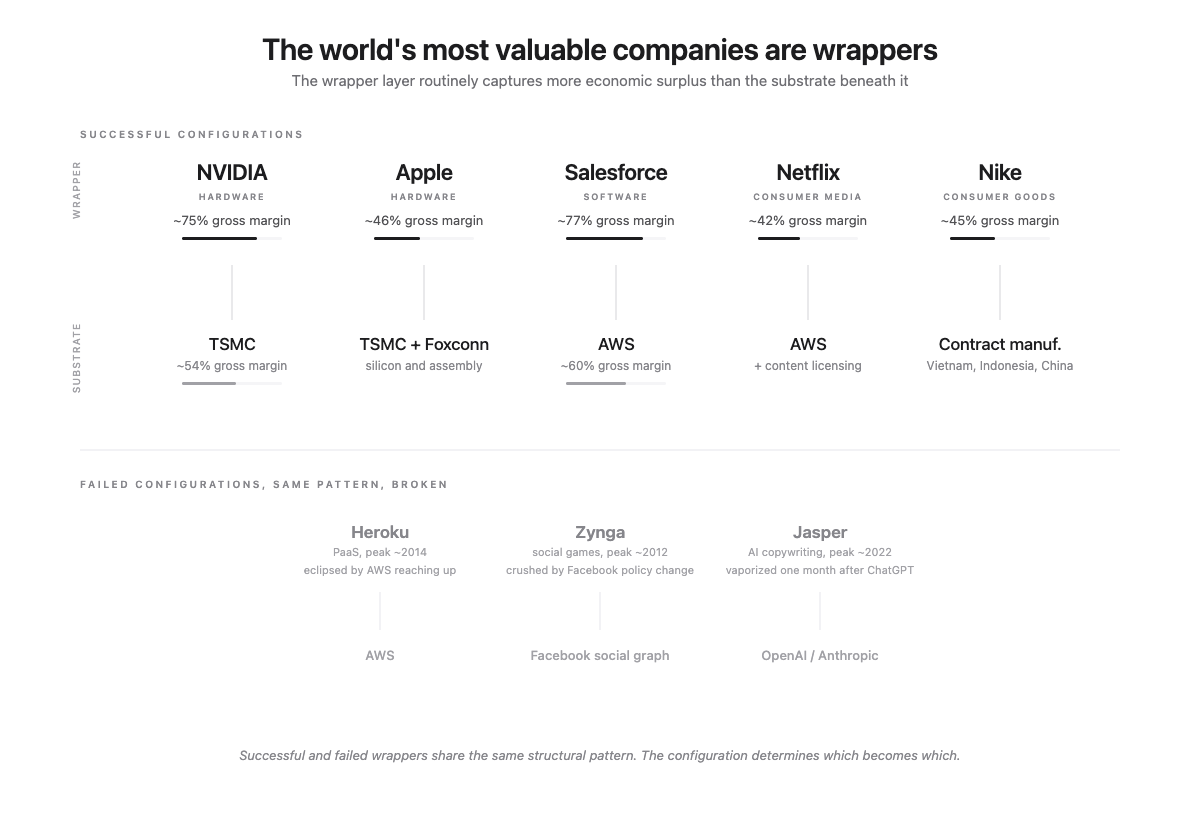
The world's most valuable companies are wrappers
The first move is to notice that, taken literally, the wrapper critique applies to almost every large company that has ever existed.
This is simply the structural shape of the modern economy once a layer becomes standardized enough to outsource.
A company finds a substrate beneath it, infrastructure, manufacturing, payments, distribution, logistics, data, capital, compute, and builds something higher-value on top. That "higher-value" is varied and multi-dimensional, but a few examples are: workflows, trust, brand, distribution, design, software ecosystem, regulatory complexity, and/or customer intimacy.
The substrate matters, but the substrate does not determine the value of what sits above it.
Calling something a wrapper, therefore, conveys almost no information by itself. The entire question is what the company accumulates above the substrate.
Software has always worked this way
Start with software, where the pattern is most obvious.
- Salesforce is a wrapper on cloud infrastructure, and before that on Oracle databases and the browser stack.
- Snowflake runs on AWS, GCP, and Azure. It is a wrapper, in the most literal sense, on three companies that also sell competing data warehouses.
- Netflix is a wrapper on AWS, content licensing, and ISP last-mile delivery.
- Stripe is a wrapper on Visa, Mastercard, bank ACH rails, acquiring banks, and compliance infrastructure. It does not move money so much as coordinate other people's money-moving systems.
- Shopify is a wrapper on Stripe, AWS, shipping APIs, payment processors, logistics providers, and merchant software.
- Datadog wraps the hyperscalers it helps customers observe.
- Bloomberg wraps raw market-data feeds licensed from exchanges.
- Robinhood spent years as a wrapper on Apex Clearing. It did not even hold the securities.
The combined market capitalization of those companies sits well north of two trillion dollars. The substrate providers underneath them did not "simply absorb them". In several cases, the substrates tried and failed (or simply co-existed).
AWS launched Redshift to compete with Snowflake. Amazon launched Prime Video to compete with Netflix. Visa has rolled out direct merchant tools. Cloud providers have built native observability products. The result was not automatic absorption. It was competition, coexistence, and market segmentation.
The presence of a powerful substrate does not eliminate the possibility of valuable companies above it. In many markets, the substrate creates the possibility of those companies.
Hardware is even more explicit
The same pattern shows up in hardware, often more starkly.
- NVIDIA does not fabricate its own chips. It designs them, builds the CUDA software ecosystem around them, owns the developer relationship, serves the hyperscalers and AI labs, and relies on TSMC to manufacture the silicon.
- Apple is a wrapper on TSMC for silicon and Foxconn for assembly.
- ARM designs instruction-set architectures and licenses them. It manufactures nothing.
- Qualcomm sits in a similar position.
TSMC's customer list is essentially a list of the world's most consequential semiconductor design companies, and almost none of them own fabs. The industry settled into this disaggregated structure over decades because the scale economics of fabrication and the scale economics of design are structurally different.
Fabrication is capital-intensive, process-driven, utilization-sensitive, and horizontal. Design is architecture-driven, ecosystem-driven, customer-specific, and application-aware.
Trying to do both inside one company is hard. Letting two companies each do one thing brilliantly is often the equilibrium.
This is the point the wrapper critique misses. A company can outsource the most capital-intensive layer in its stack and still capture enormous economic surplus if the layer it owns is the layer where differentiation compounds.
This is not only a technology phenomenon
- Nike does not manufacture most of its shoes. It designs, brands, markets, and distributes them while a contract manufacturing network does the production.
- Coca-Cola does not bottle most of the Coke the world drinks. Its global bottling network does that under license.
- Boeing outsources major structural components of the 737 to Spirit AeroSystems.
- Visa and Mastercard do not issue credit. Banks do.
Each of these companies sits above a substrate it does not fully own. Each is among the most valuable companies in its industry.
Notably, the existence/quality of a substrate beneath the company tells you almost nothing about whether the company above it is fragile or durable.
The pejorative is not always wrong
None of this means every wrapper is valuable.
That would be just as lazy as saying every wrapper is doomed.
There are real cases of wrappers that failed to generate durable value. The common pattern in these failures is that their configuration made substrate reach-up almost inevitable.
Heroku is the canonical example.
It was a beloved platform-as-a-service that ran on AWS, was acquired by Salesforce for $212 million in 2010, and then watched AWS reach upward with Elastic Beanstalk, ECS, Fargate, App Runner, and a broader suite of native developer infrastructure over the following decade. By 2020, Heroku was effectively in maintenance mode.
Heroku's critical misstep was the configuration: narrow workflow surface, dependence on a single substrate, limited proprietary asset accumulation outside the substrate's own data, and a buyer: developers, with little procurement friction to insulate the substrate's direct play.
The current AI-era examples are even more clear.
Jasper, the AI copywriting product, reached a $1.5 billion valuation in October 2022. ChatGPT launched a month later. By mid-2023, Jasper was laying off employees and revising forecasts downward.
Inflection's Pi, the consumer assistant, was effectively wound down into Microsoft despite having raised more than $1.3 billion.
Most early ChatGPT-plugin builders and generic "GPT for X" shops are now defunct.
These companies cluster in the same place structurally: low workflow depth, low substrate independence, little proprietary asset accumulation, consumer or SMB buyers with no procurement moat, low switching costs, and margins compressed in lockstep with the substrate.
Even thin-looking wrappers can create structural value
Some products that look thin at first glance create structural value the wrapper label simply cannot see.
The cleanest example is epistemic.
A product that routes the same query through multiple independent models, Claude, GPT, Gemini, an open-source model, and surfaces disagreement between them is producing something no single model can produce on its own, since no model can independently verify its own outputs.
In academic research, legal analysis, clinical decision support, financial diligence, and other domains where errors compound, this type of triangulation is existential.
Whether any given company can build a durable business on this alone is a separate question. Usually, it will need more: workflow depth, proprietary data, buyer trust, distribution, high switching costs. Nonetheless, the structural value is real.
"Wrapper" is a position, not a verdict
The mistake is treating wrapper as a verdict when it is only a position in a value chain.
- A company can sit above a substrate and be fragile.
- A company can sit above a substrate and be dominant.
- A company can sit above a substrate and capture more economic surplus than the substrate itself.
- A company can sit above a substrate and be absorbed the moment the substrate chooses to reach up.
The word alone does not tell you which one you are looking at.
That is why the current conversation around AI application companies is so unsatisfying. The market is trying to reason about a multi-dimensional space with a one-dimensional term.
The useful questions are more specific:
- What does the company own that the substrate does not?
- Where in the customer's workflow does it sit?
- Does it accumulate proprietary assets with usage?
- Are those assets substrate-dependent or substrate-independent?
- Who is the buyer?
- What does the buyer need to trust before adopting it?
- How hard would it be to switch?
- Does the company benefit from substrate cost deflation, or does competition force it to pass all of that value to the customer?
- Is the real threat the foundation model provider going direct, or an adjacent incumbent bundling the model into an existing distribution channel?
"Is it a wrapper?" is not one of them.
Where we go next
As touched on above, NVIDIA is, in the most literal structural sense, a wrapper on TSMC. It outsources the most capital-intensive layer in its stack. And yet it captures extraordinary economic surplus because of what it built above the substrate.
But NVIDIA is only half the lesson.
Dell also wrapped powerful substrates: Intel, Microsoft, and a global component supply chain. Dell did not compound the same kind of asset above them, and its margin profile reflects this.
Same broad wrapper position. Very different outcome.
Part II is about why.
Disclaimer
This article is for informational purposes only and does not constitute an offer to sell or solicitation of an offer to buy any securities. Companies referenced herein are for illustrative purposes only and do not represent investment recommendations or current EQUIAM portfolio holdings unless explicitly noted. Private investments are speculative, illiquid, involve substantial risk including complete loss of capital, and are not suitable for all investors. Past performance does not guarantee future results, and all projections are hypothetical with wide bands of potential outcomes. The information presented has not been independently verified, and readers should consult their own legal, tax, and financial advisors before making any investment decision. EQUIAM LLC makes no representations or warranties regarding the accuracy or completeness of information from third-party sources cited herein.
Connect with Our Team
Interested in learning more about our investment approach?