The Triumph of the Optimists
Why private AI rounds price at the most optimistic bid in the room, why the returns underneath look like venture, and why owning the field beats picking the name.
- 01A private round is not a market price; it is the bid of the single most optimistic investor in the room.
- 02The returns underneath have taken venture's shape: two or three names out of fifty-one drive most of the value. Late-stage AI growth is venture with a ceiling on it.
- 03Nobody can pick those names in advance, so own the field: a fund of twenty to thirty holds the winners nearly nine times in ten.
"Every company is priced for perfection." "How do they justify these nosebleed valuations?" "Right company, wrong price."
We have heard these lines in our own investment committee, from LPs, and across the table from other investors, and we have said them ourselves. Every one of them treats the gap between private and public valuations as a matter of sentiment, the fever dream of irrational investors that is bound to break eventually. We think the gap is something more mechanical.
The argument
This piece began as three separate notes written for our own internal research over the summer. Each one turned out to need the next, so we've merged them and cut some of the hairier math. We've included the details in the footnotes, so if you want to go deeper or think we've got something wrong, you can let us know.
Part One asks whether we are in a bubble and argues that the question is the wrong one. A private round is not a market price. It is the bid of the single most optimistic investor in the room, because in private markets nobody who disagrees has any way to act on their view. The measured fair value gap was 48 percent on a recent boom-era sample, and every time a real two-sided market shows up, in secondaries or at the IPO, the gap closes toward the average. The optimists are not irrational. They are simply the only ones whose number gets printed.
Part Two looks underneath the price at the outcomes, using every AI-native company that first raised at a billion dollars or more between 2021 and 2024. The returns have taken venture's shape. Two or three names out of fifty-one drive most of the value. We call it the compressed power law, and it means late-stage AI growth is venture with a ceiling on it.
Part Three follows those two facts to the data-driven conclusion. Value investing does not transfer, because the names that look cheapest are the ones nobody is defending, and the names that look most expensive are the only ones that produce the return. The winning bid was too high on almost every company and far too low on the two or three that mattered, and nobody, including the person who won the round, could have bid what those turned out to be worth. Since no one can pick them in advance, the sensible investor owns enough of the field that the winners are in the book by construction. A fund of twenty to thirty names holds them nearly nine times in ten. A single co-investment holds them about one time in sixteen.
At EQUIAM we look at a company through several lenses, and one of them is the same tool hedge funds and public-market analysts reach for, a discounted cash flow model. Ours is not one model but several. For each company we build as many scenarios as it takes to cover the genuinely different futures we can see, usually three to five, with no cap, and each one is a complete story about the world run through every line of the business: revenue, margins, costs, capital spending, debt. Then we do the research to weight each story by how likely we think it is, which gives us an expected value.
And yet over the past two years the gap between our expected values and the prices rounds actually clear at has kept widening, which forced the obvious question of what is going on. The lazy answer is that we are in a bubble and everyone else is irrational. That answer flatters the ego and is rarely correct. Most people are intelligent, rational actors, especially with their own money on the table.
To make it concrete, take a legal-AI company we looked at recently. We modeled five futures. The most pessimistic case was total disintermediation by the frontier labs, the most optimistic was the firm decoupling from 3rd party firms and becoming a platform in its own right. The scenarios ran from about $1 billion of equity value to nearly $14 billion, and the probability-weighted answer came out around $4 billion. Then a round got done at $9 billion, so the obvious question was, did the model miss something?
The model missed nothing, but it was answering a different question. A probability-weighted valuation tells you what the average informed investor thinks a company is worth. A private financing round tells you what the single most convinced investor in the room was willing to pay, because that investor sets the price and nobody who disagrees has any way to push back. You cannot short a Series D. Your skepticism leaves no trace on the price. You decline the meeting, and the price is set by whoever did not.
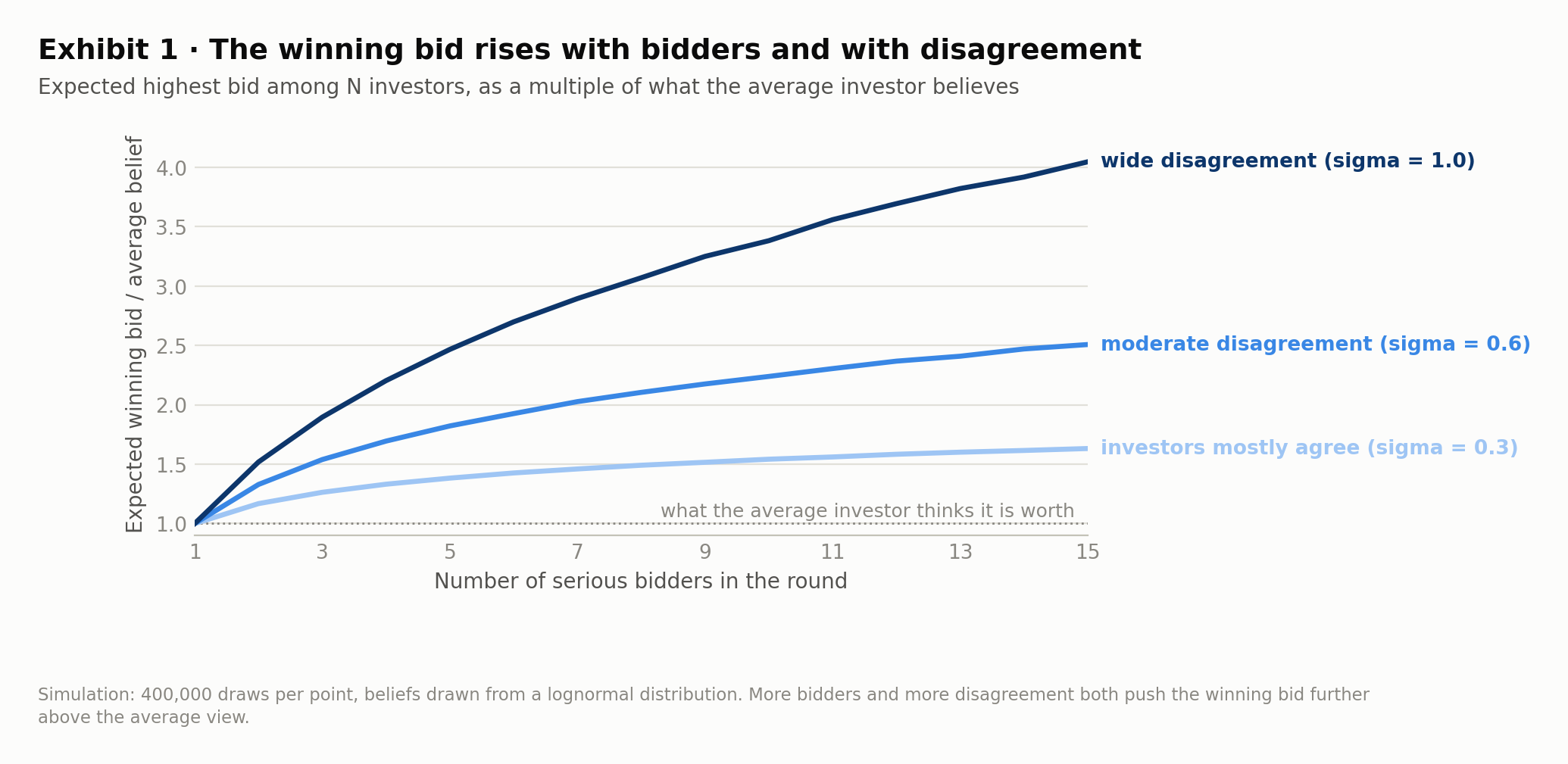
Edward Miller worked this out for public stocks in 1977: restrict short selling and a stock's price stops reflecting the average opinion and starts reflecting the optimists.1 Private markets are Miller's model with the dial turned all the way up. From there the arithmetic of a maximum does the rest. Take some number of bidders, each with their own view of what the company is worth, and the expected winning bid rises with the number of bidders and rises again with how much they disagree:2
I. More bidders, higher price
The above chart contains the most uncomfortable implication in this whole piece. Put a dozen serious bidders into a sector where opinions are wildly dispersed, frontier AI being the obvious example, and the expected winning bid runs three to four times what the average bidder believes the company is worth. More competition for a round pushes the price further into the tail rather than closer to fair value, so the hottest deals come out the most overpriced, by construction. Competitive price discovery, the thing that makes public markets honest, runs in reverse when only one side of the market exists.
II. The optimists are rational, and the number is still wrong
Before anyone concludes that the winning bidder is a fool, let's look at the data. Venture returns follow a power law, and in the Horsley Bridge data about six percent of deals produced about sixty percent of returns.3 A fund with that payoff profile is effectively a call option on the rare enormous outcome, and for the holder of that option, underwriting to the wildly bullish scenario is close to the right thing to do. A typical valuation model answers the question: "what is this company worth on average?" The lead investor is answering a different one: "what can I pay and still return the fund if this turns out to be the one?"
There is a second reason the number is inflated, which is that the security being priced is not really the company in a public market sense. The lead buys preferred stock wrapped in downside protection: liquidation preferences, ratchets, sometimes a veto over any IPO below the round price. Gornall and Strebulaev, writing in the Journal of Financial Economics, valued 135 US unicorns security by security and found the average headline valuation 48 percent above fair value, with the common shares "overvalued" by 56 percent.4 Sixty-five of the 135 stopped being unicorns once the preference stack, the set of protections that lets senior investors get paid before anyone else, was priced properly. In the companion survey, 91 percent of venture investors themselves said unicorns are overvalued. The people printing the number do not believe the number.
So the headline private valuation is built in three steps. It is the winning bid, for the most protected share in the company, applied to every share and reported as the company's value. Each step is locally defensible, and the output is then consumed by employees, LPs, crossover funds, and journalists as if it were an honest expectation. The triumph of the optimists is a matter of market structure rather than of being right.
III. What happens when a real market shows up
If private valuations are ceilings and public prices are averages, then anything that brings back two-sided trading should drag private prices down toward expected value.
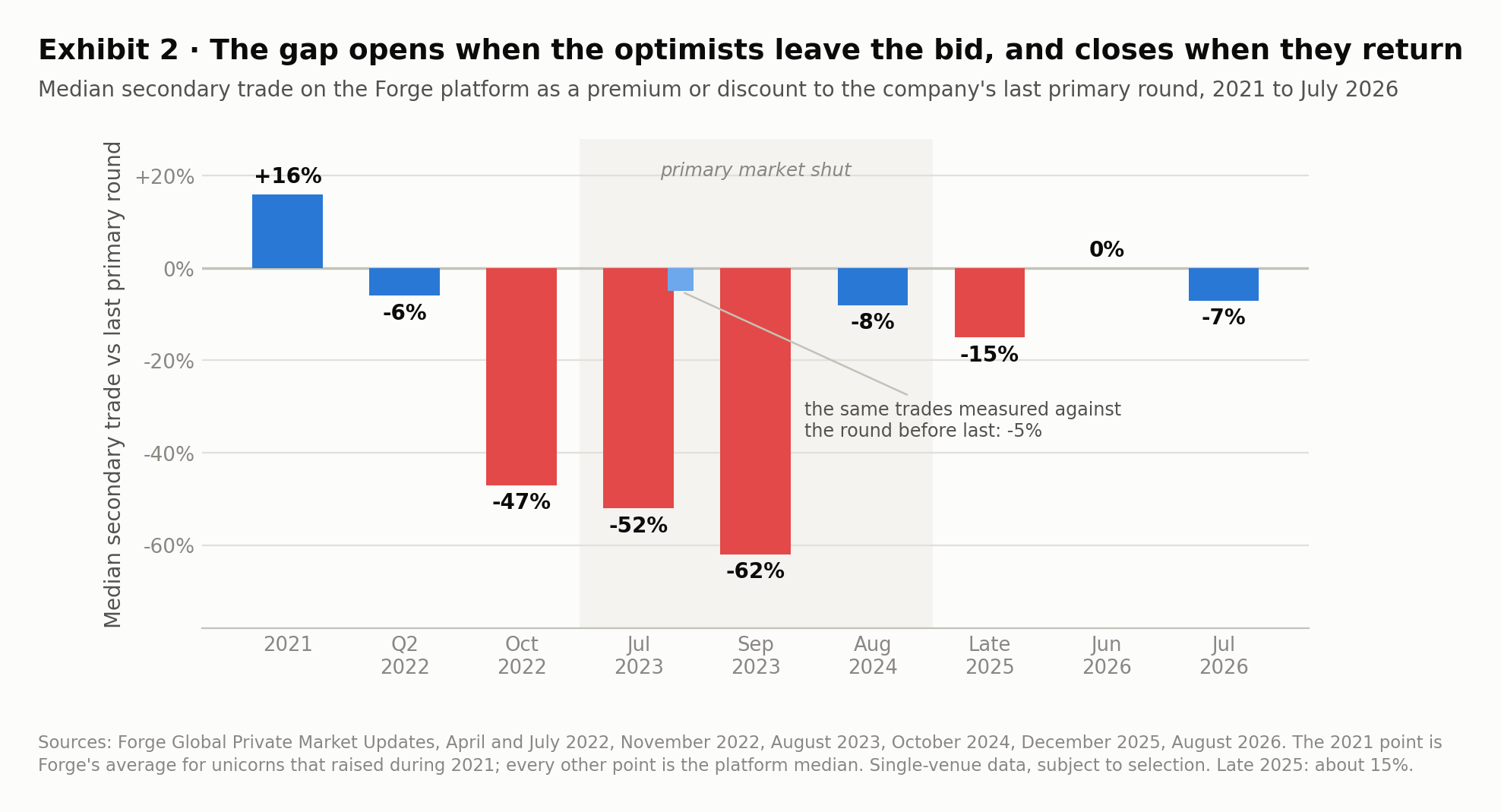
Once rate hikes all but closed the primary market in 2022, sellers on the secondary market had to find real buyers instead of leaning on whatever the last lead had been willing to pay. The shift was fast. Through 2021 the median company on Forge traded at a premium to its last round. By Q2 2022 it was 6% below, by that October 47% below, and it bottomed in September 2023 at 62% below.5 None of that is the cost of illiquidity. Transfer friction does not move sixty points in eighteen months.
What moved was the reference price, and the reason is that a primary round is never a clearing price. It is the highest bid from the most optimistic buyer in the room. Secondary is what everyone else will pay. So, the gap blew out when the primary market stopped setting prices, and it closed again once it started again. In July 2023, the median trade sat 52% below the last round, but it sat only 5% percent below the round before it.5 The market had not marked these companies down. It had erased one round of 2021 markup and stopped. Discount to last round was never measuring value. It was measuring how far the last mark had drifted from the marginal buyer. It blew out when the optimists left the room and closed again when they came back. By the summer of 2026, with the AI cycle running and most of the market repriced, the median trade was back at par in June and 7% percent below in July.
The IPO is the final exam. It begins on the first trade, when short sellers arrive, preferences collapse into common stock, and trading volume replaces conviction, and it runs through the lockup expiry six months later, when the rest of the float arrives. The 2021 vintage, priced at the modern peak of disagreement about the future, graded itself:
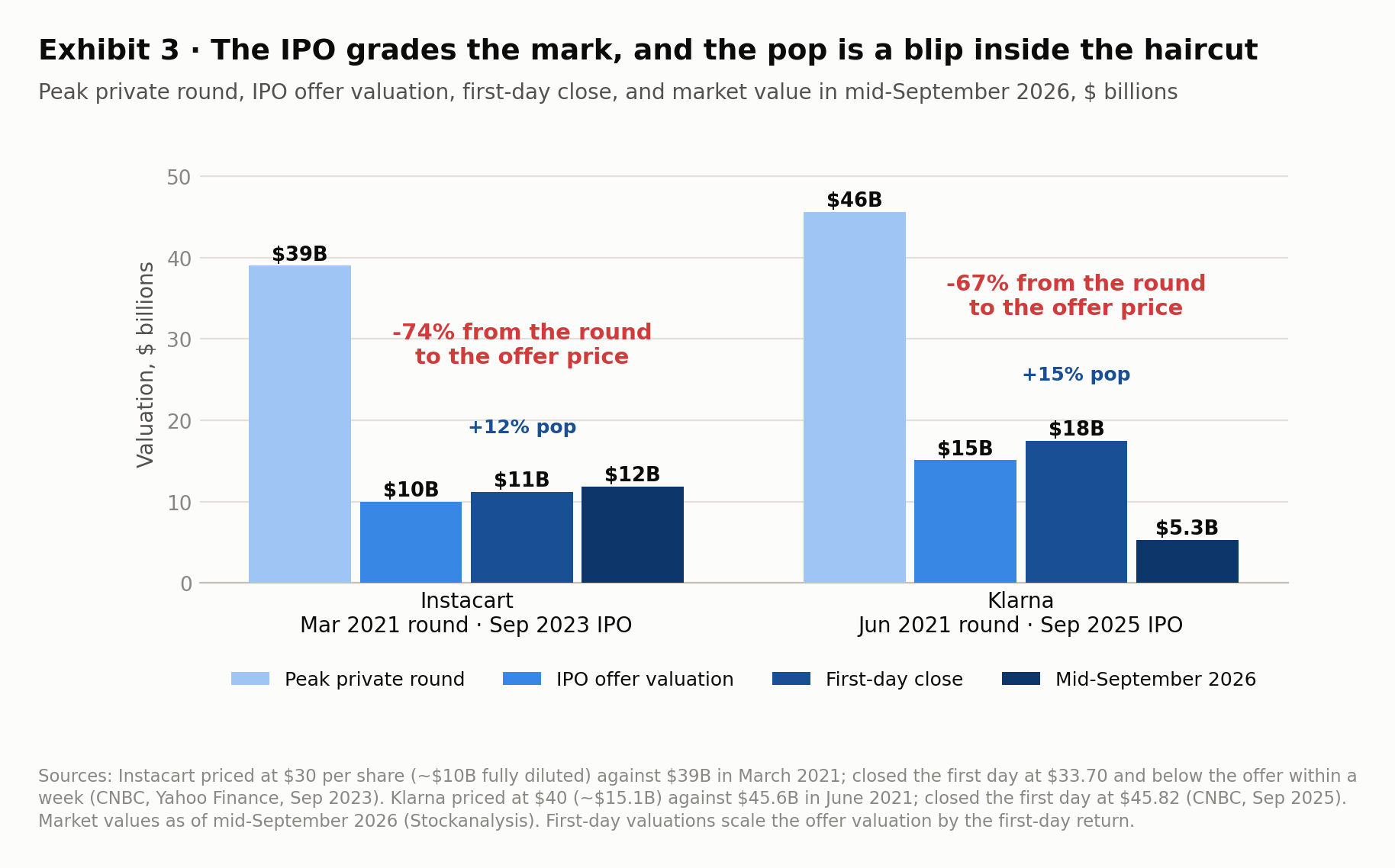
Instacart was profitable when it listed, and Klarna's offering was 26 times oversubscribed.6, 7 These were good companies whose businesses came through fine. What collapsed was the price one very convinced buyer had once been willing to pay for them.
A fair skeptic will point out that the world changed in between. Interest rates went from zero to five percent and public growth stocks lost more than half their value, so part of each haircut is simply the average opinion moving, rather than the gap between the top bid and the average view closing up. That is true, and it is why the cleanest estimate of the gap is the 48 percent cited by the study covered in Section II, which was measured on a boom-era sample of unicorns with no downturn in it at all. The secondary and IPO evidence shows the gap closing when a real market arrives. The Gornall and Strebulaev study showed it was there before any market did.
The other objection is the IPO pop. Everyone has heard of a stock that doubled on its first day of trading, so how can the IPO be the moment the price comes down? The answer is that a pop and a haircut measure different things. A pop is the distance from the offer price to the first trade, and the offer price is not a market price either. It is set the night before by the company and its bankers, who deliberately set it below where they expect the stock to open so that the institutions anchoring the book get paid for showing up. In Jay Ritter's data the average first-day return since 1980 is about 19 percent, about 7 percent in the 1980s and 65 percent in the two bubble years of 1999 and 2000.8 The haircut is the distance from the last private mark to the public price. Both of our examples popped. Instacart closed its first day up 12 percent, was below its offer price within a week, and three years later is worth about $12 billion against its peak private valuation of $39 billion. Klarna closed its first day up 15 percent and a year later trades at about a third of its offer price and nearly 90% beneath its peak private valuation. Neither pop made a dent in a haircut of two thirds or more. The pop also never reaches the private-round holder, who is locked up for six months while the allocated institutions collect it, and Ritter's long-run numbers say that once trading settles the average IPO trails comparable firms by about 3.6 percent a year over the following five years, with the worst results in the hottest years.8 So the first day of trading is the first two-sided price, and it corrects two numbers at once. It grades the bankers' price up by a fifth and the last lead's price down by half or more, and each error runs in the direction of whoever held the pen.
Of course, plenty of companies go on to compound enormously in the years after listing. But the price is now set by millions of people rather than a few dozen, reset tick by tick, day by day, on far more public information, and with the full apparatus for betting against it as well as for it. The company must earn the number rather than negotiate it, and the first years of that are often ugly.
IV. As of today, two companies define the AI trade
On the return side, while the auction was learning to charge the maximum, the asset class itself was quietly changing shape.
To avoid cherry-picking, we built the cohort before looking at outcomes: every AI-native company whose first billion-dollar round closed between 2021 and 2024. That gives fifty-one names, with no picking of winners or cautionary tales, each traced from that entry round to July 2026:9
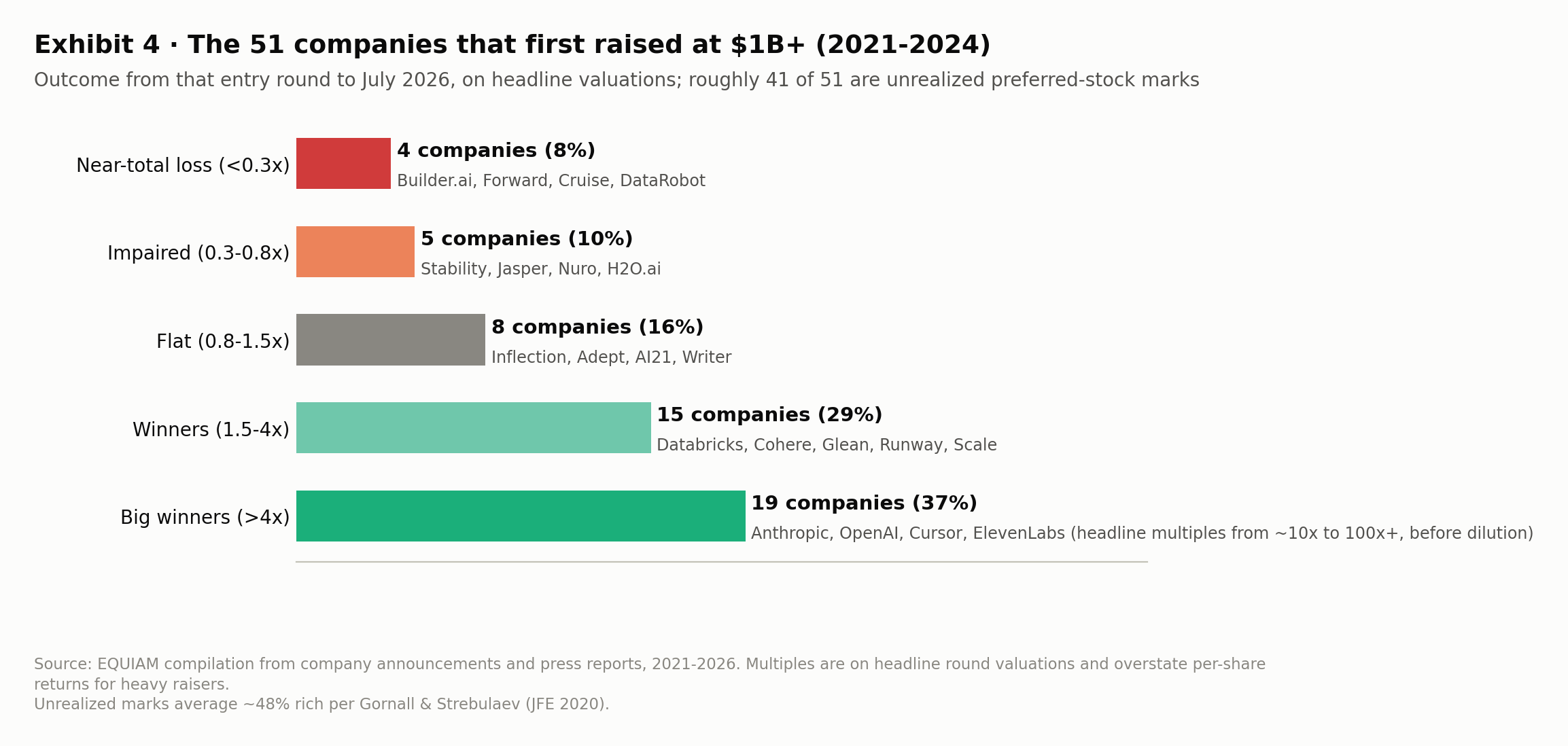
At first glance the chart flatters the asset class, with a median outcome around 3.3x and two-thirds of the cohort at or above 1.5x. Then you look at where the value actually lives.
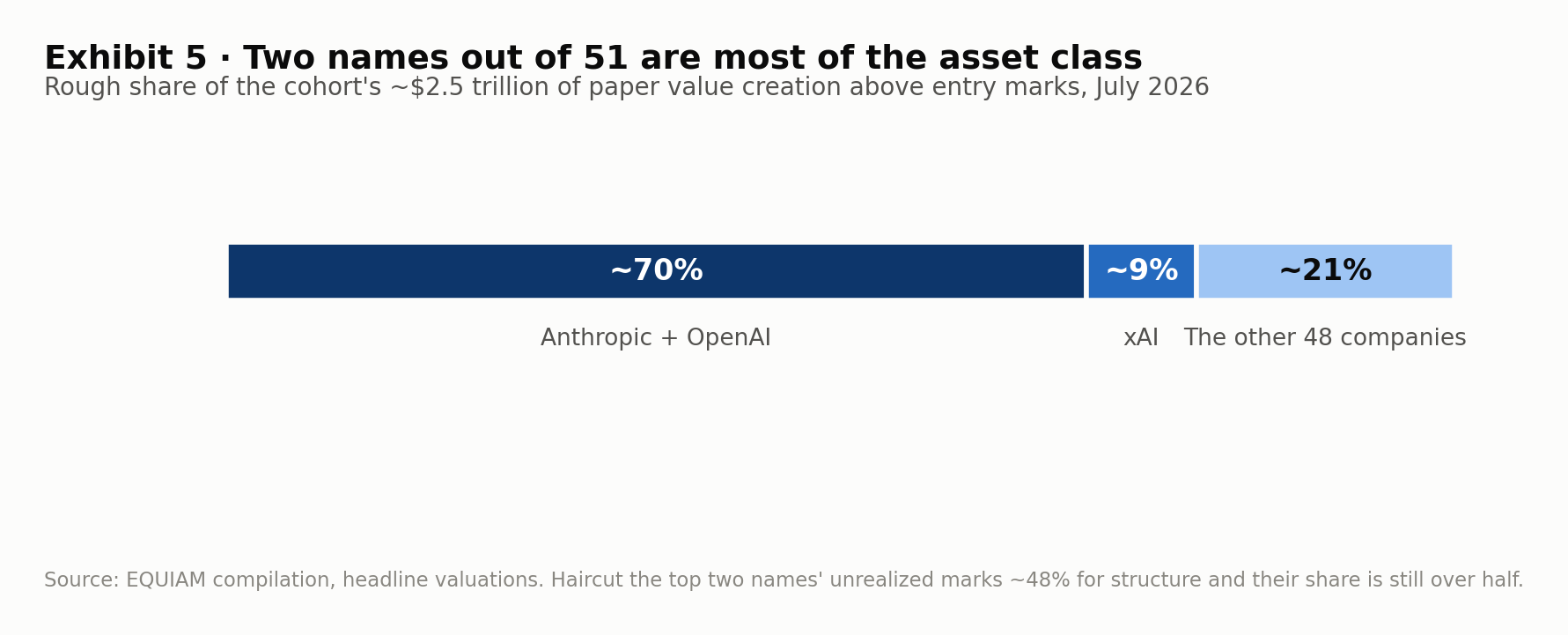
Anthropic and OpenAI alone account for roughly seventy percent of the cohort's $2.5 trillion of paper value creation, and adding xAI takes three names to nearly eighty percent. Two companies out of fifty-one are most of the asset class, and everything else is a footnote to them.
The downside is just as venture-shaped. Builder.ai went insolvent after its revenue was found to have been inflated by roughly 300 percent, Forward shut down, and DataRobot sits 70 to 90 percent below its 2021 round on the books of the mutual funds that hold it.10 The soft landings in the middle were manufactured by exactly one class of buyer: Microsoft's licensing deal returned about 1.1x to Inflection's investors, Amazon's made Adept's investors roughly whole, and Google's $2.7 billion license bought out Character.AI's backers at about 2.5x.11 A floor made of hyperscaler rescue bids, already under scrutiny from the DOJ and the FTC, is not a floor anyone can underwrite. Plan on the broken companies returning twenty cents on the dollar, and treat anything better as a gift.
V. The compressed power law
There is one more thing the chart cannot show, which is that the cohort has not aged yet. Roughly 41 of the 51 outcomes are unrealized preferred-stock marks, the kind that run about 48 percent rich, and the direct precedent for what happens to such marks is brutal: companies that last raised in 2021 are now marked down 68 percent on average, more than 220 former unicorns have fallen below the billion-dollar line, and nearly half of all US unicorns have not raised money in more than two years.12 Today's middle band of stale marks is where the write-downs of 2027 and 2028 will come from, which makes this chart the before photo.
Part of the reason the outcomes range this widely is that the revenue underneath them is a different substance from the software revenue the multiples were calibrated on. The median AI-native company keeps far less of its revenue base from one year to the next than a software company does, and compute eats a share of every dollar that software never had to give up.13 Uncertainty at the revenue line becomes uncertainty at the outcome line, and wide-open outcomes are what venture is.
Within the cohort, the correlation between how expensive a company's entry round was and how it turned out is essentially zero, and the outcomes above 8x are spread evenly across cheap, middling, and expensive entries.14 Cheap did not help and expensive did not hurt, so price, at the level of a single name, told you nothing about which company would matter.
Late-stage AI growth investing has stopped behaving like growth and started behaving like venture. Historically, growth investors expected relatively tight outcomes, with max single-company impairments of 30-50% and max upside outcomes of 3x-4x. The historical return distribution has blown out considerably in recent years. We refer to this new distribution as the compressed power law. It is compressed at the top since the 100x-1000x that makes seed portfolios legendary is close to unreachable at the growth stage, where the entry price already assumes most of the outcome. It is compressed at the other end too, with fewer outright zeros, because a company this far along usually has revenue, customers, or a team somebody will buy for parts. Between those bounds the shape is venture's, with the winner concentration to match. The 25x-50x outcomes that many Anthropic and OpenAI investors have achieved over the past few years are the proof, and they point to a category of outcome that sits somewhere between venture and growth.
VI. Why value investing does not transfer
A corollary before the payoff, because it will save somebody reading this a great deal of money. The value investor's playbook does not work in this market, and the reason is more interesting than "there are no bargains."
The playbook assumes a price can drift below what a company is worth because the crowd is inattentive or frightened, and that patient capital gets paid for correcting the error. In a market where the printed price is the top bid, a company trading far below its last round has not been overlooked. Other people are also smart and it's unlikely you have just uncovered a gem no one else knew about. It has been looked at hard, and the most convinced person willing to write a check will not pay more. The names that trade cheap and freely are, for the most part, the names nobody is defending: stale marks, broken 2021 cap tables, and insiders getting out at whatever the market will bear. The winners, by contrast, ration their float. OpenAI and Anthropic declared in May 2026 that unauthorized share transfers are void, and their sanctioned liquidity runs through controlled tenders at or near the round price.15 Quality supply almost never reaches an open ask. The trading data reads exactly the way you would expect:16
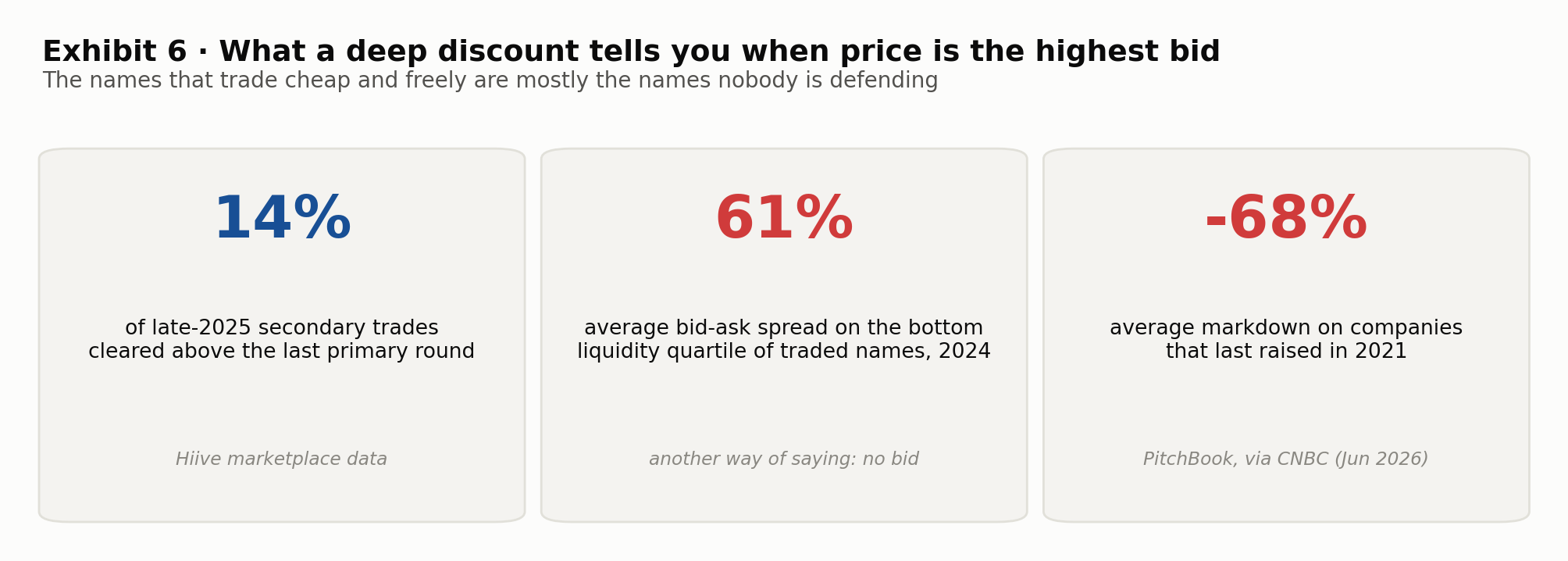
The 2021 cohort ran this experiment at scale. Given the 68 percent markdown from Section V, a buyer who took a fifty percent discount in 2023 as a bargain is still, on average, down about a third from there. The fair caveat is that plenty of employee selling is pure need for cash, and in companies that later went public, the median employee who sold beforehand left 47 percent on the table according to Stanford's Larcker, Tayan, and Watts, so a discount alone convicts nobody.17 The tell is whether the company sanctions the sale. A tender at the round price is liquidity. Unsanctioned stock at forty cents on the dollar is usually a burning ship, and the people closest to the fire are selling you their seats.
One related distinction is worth keeping. Sometimes a very good company trades well below its last round and the right move is simply to buy it. Stripe raised at $50 billion in early 2023, down from $95 billion in 2021, and was back near the old mark within two years.18 So the question is never whether there is a discount. It is what the discount is telling you. A discount offered because capital is scarce everywhere, as it was in 2023, is the average opinion showing up, and it is the one moment this market hands you something close to a fair price. A discount offered on a single name while capital is abundant everywhere else is the sellers knowing something. The first is worth waiting for. The second is the burning ship.
A value screen computes what a company is worth, buys below that number, and passes above it. Now ask which companies carry the widest premium over that number. They are the ones informed people disagree about most, the moonshots, where the bull case is a platform that reorganizes an industry and the bear case is irrelevance. Those are the rounds a value screen declines.
Anthropic raised at roughly $18 billion in early 2024. By every yardstick we use, that number looked like a stretch. We invested anyway, because our process asks about the shape of the return distribution rather than a single fair value, and the shape said yes. Today the shares from that round are worth ~twenty times the entry point, after all the dilution since.19 The lead investor in that round was the most optimistic person in the room, and the most optimistic person in the room was not nearly optimistic enough. OpenAI ran the same play in public. Employees sold into a tender at roughly $86 billion in early 2024, and that October the company raised at $157 billion.20 Both prints drew the same reaction, that the business was unlikely to grow into the number and the price was a reflection of exuberance more than sound economics.
EQUIAM was part of that reaction, at least on one of the two. While we invested in Anthropic, we passed on OpenAI in the October round, and the reason we gave ourselves was structural rather than about price. The relationship between the nonprofit and the capped-profit entity was opaque at the time, and we could not get comfortable with what a shareholder would actually own. But if we put all our cards on the table, the valuation was discussed in the room too. It was one of several reasons we passed, but not the primary one. We had many conversations with CIOs, LPs, and other sophisticated investors who treated the question as settled, and the settled answer was that anything near $100 billion made no economic sense.
By March 2026 OpenAI closed a $122 billion round at $852 billion. It filed confidentially for a listing in June, and its CFO has since told staff to expect 2027.20 What any individual holder made across that run is not cleanly computable, and the reason is the thing we flagged in 2024. Until October 2025, investors and employees held capped profit participation units rather than stock. The recapitalization into OpenAI Group PBC converted those units into ordinary shares and removed the cap, and the conversion ratio was never made public.21 So the honest claim is about the company rather than the holder. The mark went from roughly $86 billion to $852 billion in two years. We were right that the structure was opaque. We were wrong about what the business was worth.
This is what a power law does to prices. For most of the companies in our cohort, the winning bid was too high, and the market has spent three years grinding those marks back toward reality. For two or three of them, the winning bid was far too low, and those two or three are most of the return of the asset class. The auction overprices almost every company and still leaves the winners on the table, because nobody, including the person who won the round, can bid what the winner eventually turns out to be worth. A discipline built around passing on anything that looks expensive would have kept you out of every one of the names that mattered. Our own cohort said the same thing in Part Two, in a less dramatic way: entry price told you nothing about which company would matter.
Our internal modeling is not simply a DCF which produces a fair price that we refuse to pay a cent above. It produces a distribution. The expected value tells us what the company is worth on central assumptions, and therefore how large a premium the market is charging over it. The scenarios around that value tell us how far the good case runs, and whether it runs far enough to be worth the premium.
That gives us a rule. When a company's outcomes bunch around the mean, the premium is pure cost and we pass. When the distribution is skewed hard to the upside and the outsized case is real, the premium can be worth paying. Size follows from how far the skew runs and how much of the downside we can survive.
Anthropic was one of those, and we sized the position accordingly. We did not know it would be one of the names that defined the cycle, and the method did not require us to.
The test lets in more names than will work. That is by design. Every one of those names is a data-informed risk and reward argument in our investment committee, and the model codifies the assumptions, so the debate runs on inputs rather than conclusions. What to do with the names the test lets in is the next section.
VII. Own the field, not the name
Which brings us to the question almost everyone actually asks about this market: should I just buy the obvious winner? Well, the answer is yes! If you know the winner, put all your money in that single asset and ride it all the way up. If you can accurately predict the future, feel free to skip this section. For those of us without access to Doc Brown's DeLorean, read on.
Buying one or two names, whether directly alongside a fund, through a special purpose vehicle, or in the secondary market, is the worst-odds way to express a thesis that is otherwise correct. A diversified fund built on the same thesis beats the concentrated bet, and beats it by design rather than luck.
There are two kinds of single-name buyers. One is the institution invited to co-invest, meaning to put extra money directly into one deal alongside the fund that led it. The other is the individual or family office buying through whatever channel will sell to them.
On any given deal you face a choice between paying the top price and walking away. Pay, and you own one name at that price, with a real chance of a wipeout and long odds that it is one of the three names that matter. Walk away, and you have just declined Anthropic. Both moves lose, and the co-investor has to make one of them on every deal.
The co-investor buys at a disadvantage on three fronts at once. They see the deal only after the auction has set the price, and pay that price without the information rights or the board seat the lead gets in return. The supply is adversely selected: the rounds offered to outsiders in size are the largest rounds in the hottest markets, because that is when leads need help filling them, so entries cluster near the worst prices the market charges. And in recent years the opportunities have arrived padded with fees, upfront and again on the back end if you are lucky enough to pay carry (typically through multilayer SPVs).
An investor who already owns a company usually holds the right to buy its share of every later round, which the industry calls pro-rata. That right is how a fund keeps buying into a winner as the winner reveals itself, and it is why the funds that owned Anthropic at $4.1 billion in 2023 also owned it at $18.4 billion and at $61.5 billion, without having to win a fresh auction each time.19 A co-investor gets one shot at one price on one day, with no claim on the next round.
Now look at why picking the name was never a realistic plan, using the field as it actually stood at the start of 2024:9
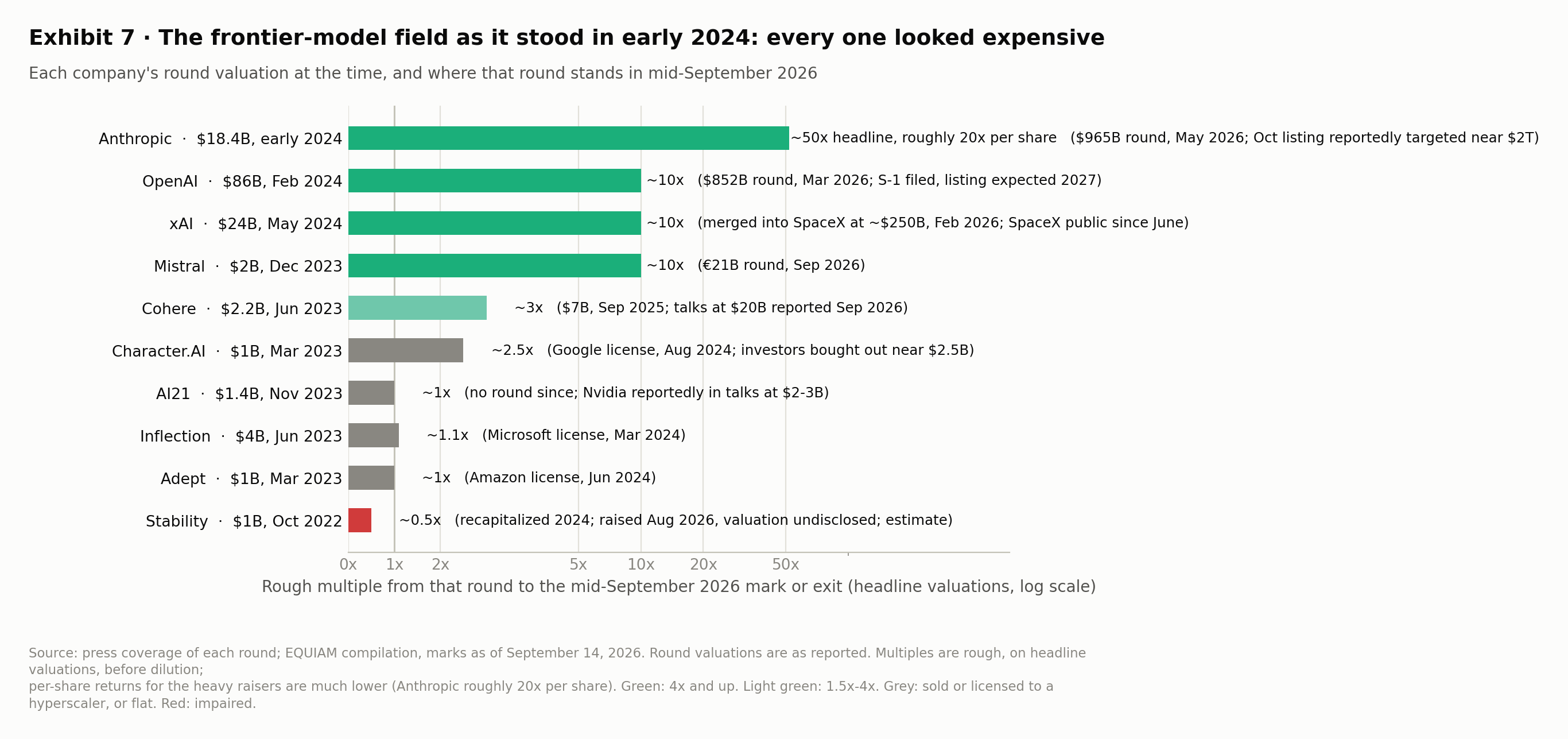
Every company on that chart looked expensive at the time, and the "obvious winners" list of that moment had Inflection on it, with a $4 billion valuation, a founding team out of DeepMind, and Microsoft as its partner. Within a year three of these companies had been sold for parts to hyperscalers and several had gone flat. Two and a half years on, three have raised or merged at roughly ten times their rounds, and one has gone up something like twenty times per share. Nothing about the prices separated the winners from the rest. The best-informed buyers on earth missed at close range: Microsoft was inside Inflection and wound the bet down, and SoftBank funded Builder.ai into insolvency.11 Public markets have run this experiment for a century. Bessembinder found that four percent of US stocks account for the entire net wealth creation of the market since 1926, and that most stocks lose to Treasury bills over their lifetimes.22 Markets shaped like this pay the people who hold the whole population and punish the people who hold a small sample of it, and AI growth is as skewed a population as any of us will ever underwrite.
All of this dissolves the moment the question changes. For a single name, the question stops being "is this cheap" and becomes "does the shape of its outcomes justify the premium, and at what size." For the book, the question becomes "do I own enough of the field." Here is what the second question looks like on the AI cohort's own marks, with the biggest winners deliberately tamed. Anthropic is carried at about 20x, which is roughly its per-share gain from the $18 billion round, rather than the 50x or more its headline valuations would imply, and OpenAI is carried at about 15x on the same logic:23
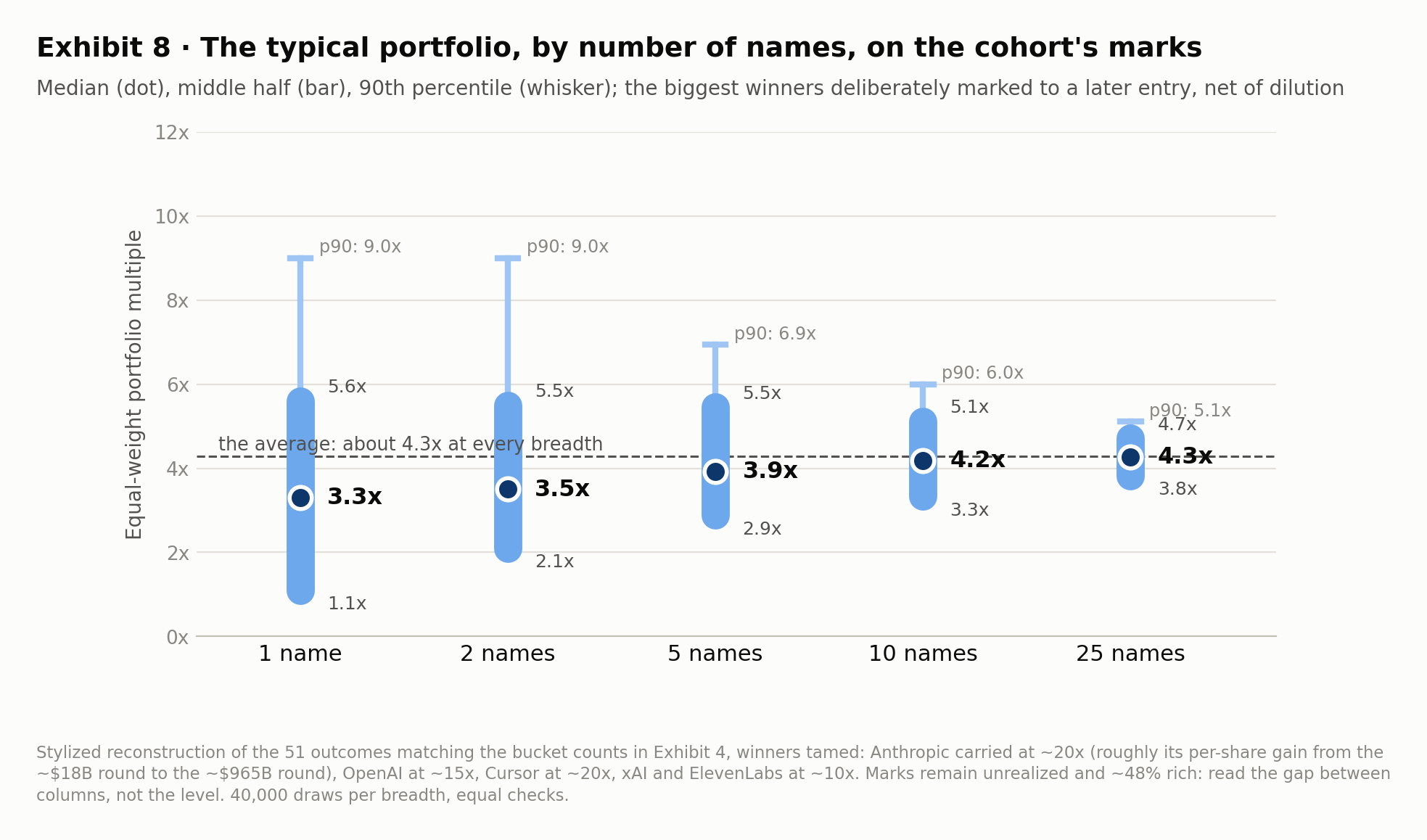
The chart above shows what Harry Markowitz called the only free lunch in investing.24 Spreading your bets narrows the range you might land in, and in venture it also lifts the outcome you are likely to get.
Reading the chart from left to right, a buyer of a single name gets the median company, about 3.3x on paper, and a quarter of those buyers end up at or below roughly 1.1x, which is a loss once the richness of those marks is taken out. A buyer of twenty-five names, drawn from the same fifty-one companies at the same prices, sits at about 4.3x, and the unlucky quarter of those buyers still clears 3.8x, comfortably above the single-name buyer's median. The only thing that differs between those columns is the odds of holding the names that carry everything, which go from about six percent at one name to nearly ninety percent at twenty-five.23
To be fair to the concentrated buyer, the whiskers on Exhibit 8 show that with fewer names the highs are higher. Own one name and a 20x outcome is a 20x outcome. Spread the same money across twenty-five names and that one winner adds less than 1x to the whole book. On these marks the luckiest single-name buyers made 15x to 20x, and no basket will ever print a number like that. Concentration is a genuine lottery ticket, and it is priced like one. The top whisker is real, but nobody can underwrite to it.
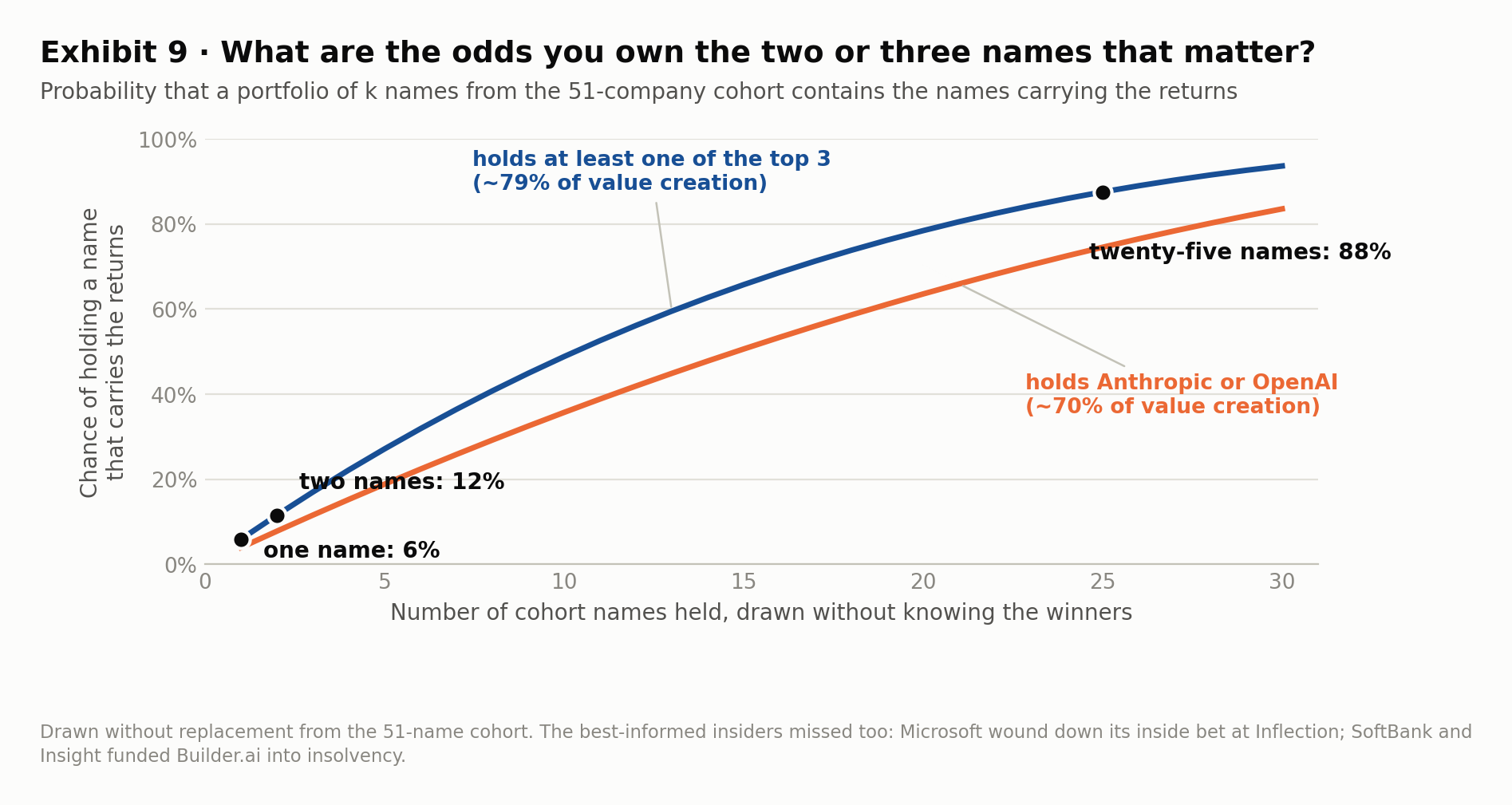
Nobody can say whether Anthropic's $965 billion round, or the roughly $2 trillion reportedly being discussed for an October listing, is another $18 billion moment or another Instacart-at-$39-billion moment, and owning the field means nobody has to.19
The difference between a great fund and a mediocre fund is two or three companies. Strip them out and late-stage AI is a middling business, with real losses, modest winners, and a premium paid at entry that eats most of the spread. Put them back and it is one of the better places capital has been in a decade.
None of this is new to venture-style investing. Cambridge Associates tracks every US venture fund in its benchmark back to 1981, more than 2,800 of them. The median fund in that history returned about 1.4 times its investors' money after fees, about nine percent a year, and the lower-quartile fund did not quite return the money. The asset class as a whole, with every fund's cash flows pooled together, returned about 2x and seventeen percent a year. In buyout and growth equity over a similar span, the median fund and the pooled asset class are nearly the same number:25
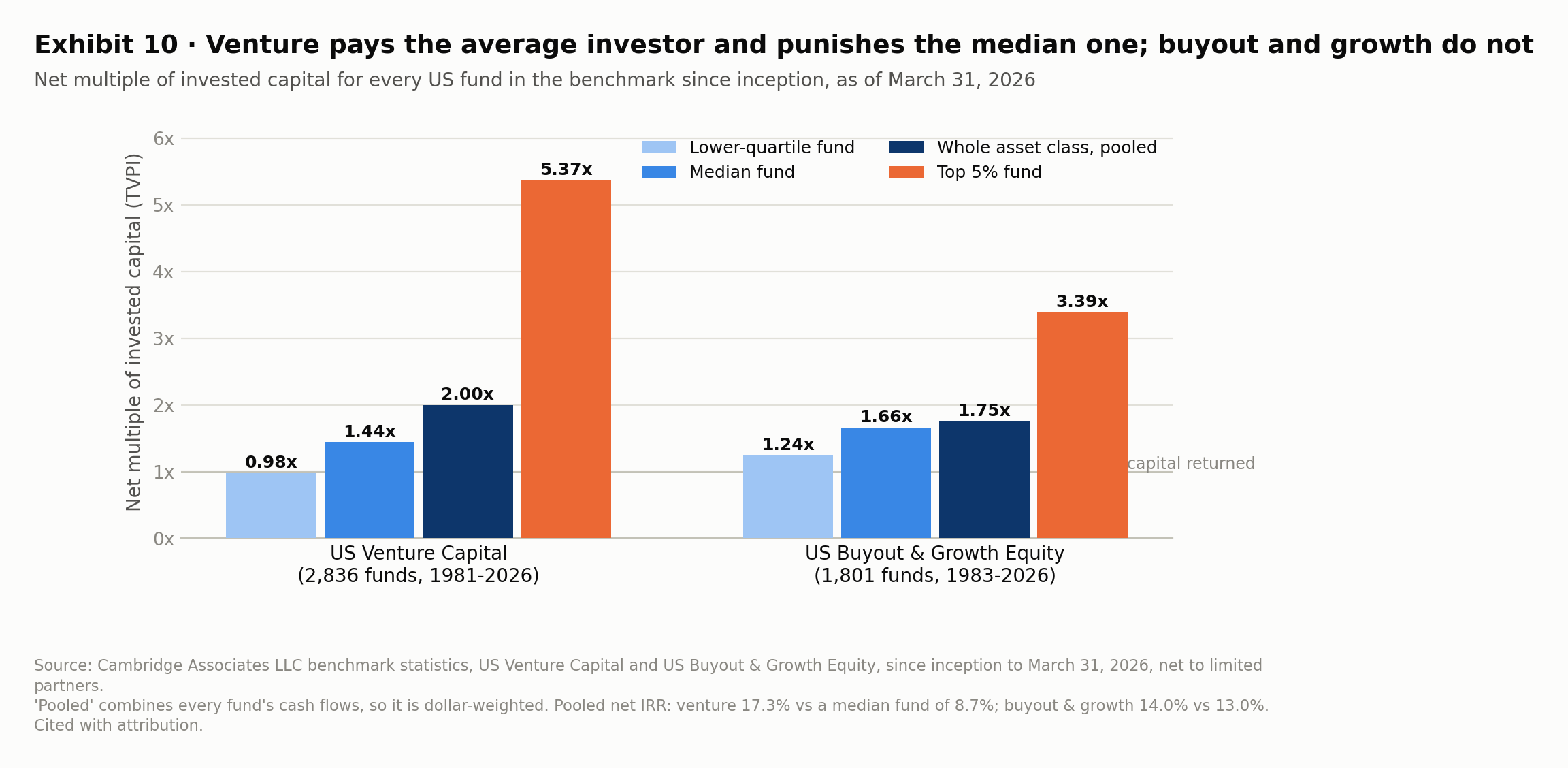
That gap is the winners, sitting in the funds that happened to hold them. The same shape shows up at every level you measure it, from deals to funds to whole vintages. The one thing the AI cohort changes is how catchable the tail is. In early-stage venture, the deals that return fifty times or more are a small fraction of one percent, so even a hundred-name fund frequently holds none.26 In this cohort the names that carry the returns are three in fifty-one. The cap that limits the size of the winners is the same thing that makes them common enough to catch. That is the compressed power law's one gift, and it is a large one.
The two triumphs
A last word on the phrase we stole for the title of this piece. Dimson, Marsh, and Staunton called their book about a century of equity returns Triumph of the Optimists.27 The equity market optimists in their book earned the name because they held through two world wars, a depression, and every crisis the twentieth century could produce. The equity premium was real, and a hundred and one years of sitting still collected it.
The optimists in the current environment triumph differently. Winning the auction means writing the largest check, and on most names, it is too large. But the check is the entry ticket. The pessimists who refused to write it never own the companies at all, and on a small number of those companies the most optimistic bid in the room still turned out to be far too low. That is the whole of it. The optimists of the last century were right about a hundred years. When the dust settles, we suspect the optimists of this one overpay on most of the field, underbid on two or three without knowing it, and stay long enough to find out which was which. Nobody overpaid for Anthropic in early 2024. They only thought they had.
Sources and notes
- Miller, E. M. (1977). "Risk, Uncertainty, and Divergence of Opinion." Journal of Finance 32(4), 1151-1168.
- EQUIAM simulation for Exhibit 1: 400,000 draws per point, beliefs drawn from a lognormal distribution. The expected maximum of N draws rises with N and with the dispersion of beliefs. Code available on request.
- Horsley Bridge portfolio data (7,000-plus investments, 1985-2014), via Mallaby, S., The Power Law (2022), and a16z, "Performance Data and the Babe Ruth Effect in Venture Capital": about 6 percent of deals produced about 60 percent of returns.
- Gornall, W., and Strebulaev, I. A. (2020). "Squaring Venture Capital Valuations with Reality." Journal of Financial Economics 135(1), 120-143. 135 US unicorns; reported valuations average 48 percent above fair value; common shares 56 percent overvalued; 65 of 135 lose unicorn status once the preference stack is priced. The 91 percent figure is from the companion investor survey reported in the same paper.
- Forge Global, Private Market Updates. July 2022: Q2 2022 trades at an average 6 percent discount to the last round, "after consistently trading at a premium." April 2022: unicorns that raised during 2021 traded at an average 16 percent premium to that round. November 2022: 47 percent median discount through October. August 2023: July 2023 median 52 percent below the last round and 5 percent below the round before it. October 2024: September 2023 trough of 62 percent; 8 percent discount in August 2024. December 2025: about 15 percent in late 2025. August 2026: par in June 2026 and a 7 percent discount in July 2026. Single-venue platform data, subject to selection.
- Instacart (Maplebear) IPO, September 2023: priced at $30 per share, roughly $10 billion fully diluted, against $39 billion in March 2021; closed the first day at $33.70, up 12 percent, and closed below the offer price a week later. CNBC, September 19, 2023; Yahoo Finance, September 26, 2023. Market value about $12 billion in September 2026 (Stockanalysis).
- Klarna IPO, September 2025: priced at $40 per share, about $15.1 billion, against $45.6 billion in June 2021; about 26 times oversubscribed; closed the first day at $45.82, up 15 percent. CNBC, September 10, 2025. Trading near $14 per share, about $5.3 billion, in mid-September 2026 (Stockanalysis).
- Ritter, J. R., "Initial Public Offerings: Updated Statistics," University of Florida, updated February and July 2026. 9,253 US IPOs from 1980 to 2024: average first-day return 18.9 percent (7.2 percent in the 1980s, 64.6 percent in 1999-2000, 32.1 percent in 2021). Measured from the first closing price, IPOs underperformed firms of the same size by about 3.6 percent a year over the following five years. For 2001-2024, IPOs with a positive first-day return trailed style-matched firms by about 10 percent over three years.
- EQUIAM compilation: the 51 AI-native companies whose first $1 billion-plus round closed between 2021 and 2024, traced from that round to July 2026 on headline valuations. The individual company marks cited in the text and in Exhibit 7 are as of mid-September 2026. Multiples on headline valuations overstate per-share returns for heavy raisers, and multiples between rounds are rough because dilution is not public. Company-level table available on request.
- Bloomberg, July 30, 2025, on Builder.ai's insolvency and revenue overstated by roughly 300 percent. Bloomberg, July 6, 2026, on mutual-fund markdowns of DataRobot and other private software holdings.
- Microsoft's $650 million licensing and hiring deal with Inflection (Fortune, March 2024; about 1.1x to investors); Amazon's deal with Adept (June 2024); Google's $2.7 billion license with Character.AI at about 2.5x to backers (The Information, August 2024). FTC staff report on AI partnerships and investments (January 2025); reported FTC inquiry into the Microsoft-Inflection arrangement (Wall Street Journal, June 2024). SoftBank's backing of Builder.ai per Bloomberg, July 2025.
- PitchBook data via CNBC, "Disrupted or Dead" (June 1, 2026): companies that last raised in 2021 marked down 68 percent on average; more than 220 former unicorns below $1 billion. PitchBook, Q2 2026 Global Unicorn Tracker: 47.6 percent of unicorns have not raised in more than two years.
- ChartMogul, "The SaaS Retention Report: The AI Churn Wave" (December 2025 data): median gross revenue retention 40 percent for AI-native companies against 63 percent for B2B SaaS in the same sample. Kruze Consulting on compute and hosting at about 24 percent of revenue for AI startups. ICONIQ Growth, "State of AI" (January 2026): average AI product gross margin 52 percent against the mid-70s for public SaaS.
- EQUIAM analysis of the 51-company cohort: rank correlation between entry-round valuation and outcome multiple of about +0.16 (p = 0.28); outcomes above 8x are spread across cheap, middling, and expensive entry terciles. Code available on request.
- Anthropic and OpenAI statements, May 12, 2026, declaring unauthorized share transfers void; tokenized interests in both fell roughly 40 percent the next day (CoinDesk, May 13, 2026). Sanctioned liquidity runs through company-run tenders, for example OpenAI's October 2025 employee tender.
- Hiive marketplace data (2025 Annual State of the Private Market; State of the Pre-IPO Market 2026), as compiled by Venture Secondaries (2025): 14 percent of late-2025 trades cleared above the last primary round; about 61 percent average bid-ask spread in the bottom liquidity quartile of traded names in 2024. Secondary-sourced.
- Larcker, D. F., Tayan, B., and Watts, E. (2018). "Cashing It In: Private-Company Exchanges and Employee Stock Sales Prior to IPO." Stanford Closer Look Series. Among companies that later went public, the median employee seller sold at a 47 percent discount to the eventual IPO price.
- Stripe: $600 million Series H at a $95 billion valuation (March 2021, CNBC); $6.5 billion Series I at $50 billion (March 2023, TechCrunch); employee tender at $91.5 billion (February 2025, CNBC). Later tenders valued the company at $106.7 billion (September 2025, Bloomberg) and $159 billion (February 2026, CNBC).
- Anthropic rounds from company announcements and press coverage: $4.1 billion (May 2023), $18.4 billion (January 2024), $61.5 billion (March 2025), $965 billion Series H (May 2026). The per-share gain from the January 2024 round to the Series H is roughly 20x by EQUIAM's estimate, against a headline multiple above 50x. An October 2026 Nasdaq listing near $2 trillion has been reported as a target, not a closed event (press reports, September 2026).
- OpenAI: employee tender at about $86 billion (February 2024); $157 billion round (October 2024); $122 billion round at $852 billion post-money (Bloomberg, March 2026); confidential S-1 filed June 8, 2026; CFO Sarah Friar told staff on August 19, 2026, that the company "will be a public company in 2027" or sooner (CNBC).
- OpenAI recapitalization, October 28, 2025: the for-profit became OpenAI Group PBC, controlled by the OpenAI Foundation; profit participation units converted to ordinary shares and the profit cap was removed. Company announcement and press coverage. The conversion ratio was not disclosed publicly.
- Bessembinder, H. (2018). "Do Stocks Outperform Treasury Bills?" Journal of Financial Economics 129(3), 440-457. The best-performing 4 percent of listed companies account for the entire net wealth creation of the US stock market above Treasury bills from 1926 to 2016, and most individual stocks underperform Treasury bills over their lifetimes.
- EQUIAM simulation for Exhibits 8 and 9: a stylized reconstruction of the 51 outcomes matching the bucket counts in Exhibit 4, with Anthropic carried at about 20x, OpenAI at about 15x, Cursor at about 20x, and xAI and ElevenLabs at about 10x; 40,000 equal-check portfolios drawn without replacement at each breadth; holding probabilities computed exactly. Code available on request.
- Markowitz, H. (1952). "Portfolio Selection." Journal of Finance 7(1), 77-91. The description of diversification as the only free lunch in investing is commonly attributed to Markowitz.
- Cambridge Associates LLC, benchmark statistics, US Venture Capital (2,836 funds, vintages 1981-2026) and US Buyout & Growth Equity (1,801 funds, vintages 1983-2026), since inception to March 31, 2026, net to limited partners. Venture: pooled TVPI 2.00x, median 1.44x, lower quartile 0.98x; pooled IRR 17.3 percent, median 8.7 percent. Buyout and growth equity: pooled TVPI 1.75x, median 1.66x. Cited with attribution; the second benchmark combines buyout and growth equity.
- Correlation Ventures, "No, We're Not Normal" (2019), 21,000-plus US venture financings: 65 percent return less than 1x; about 4 percent return 10x or more; the 50x-plus share is a small fraction of one percent.
- Dimson, E., Marsh, P., and Staunton, M. (2002). Triumph of the Optimists: 101 Years of Global Investment Returns. Princeton University Press.
Connect with Our Team
Interested in learning more about our investment approach?